5 reasons why I didn't choose an R1
Announcing: I've accepted a tenure-track research and teaching faculty position! But here's why R1s weren't a priority for me this job cycle.
I cast a wide net this job market season. I wasn’t sure where the jobs would be, and I was pretty confident that things would be competitive (since the state of industry means more people who are on the fence about industry might become tempted by faculty positions). And the state of the US means that faculty positions overseas, I reckoned, would be especially competitive.
But I’ve been planning to get into academia since I left industry in 2021, so I wanted to really examine all of the pros and cons of the different styles of academic life I could end up living.
Research staff at an R1: I had already done research staff work back in 2017 and 2018 at Northwestern, and I wasn’t interested in that lifestyle. It didn’t pay great, but also had no job security (I survived a big culling they did in 2018, but that motivated me to look for employment elsewhere - if the pay is lower than industry but I’m still treated as expendable, like an industry job, then why stick around?).
Research scientist at an R1: I could have looked for the few “research scientist” roles, at places like CMU, Stanford, and so on, where you just do research 24/7 and have your own grants and agenda, but the problem with those is that you have to have a very high output level before starting, which I don’t have. And pretty much all of the openings that I saw explicitly prioritize AI/ML research over everything else (because, of course, that’s where the money is at 🙄).
TT research faculty at an R1: Now, the tenure-track (TT) research faculty roles at R1s are tempting to me. You get tenure. That rules. And the bar for research output is lower than a pure research scientist role. And the bonus? You are expected to teach a little bit. (I love teaching.) This all seems great! And I’m sure that in an optimal environment, an R1 could be a good fit for me. However… let’s break down a few reasons why this kind of work isn’t ideal for what I want:
5 reasons that TT research faculty roles at an R1 aren’t ideal for me, personally
1. Funding
The biggest reason that R1s became less of a priority to me happened due to all of the cuts in 2025. I watched the folks who do accessibility research at UW, UC Irvine, U Mich, and many other places lose funding. Stacy Branham, one of the people I look up to the most in our little corner of the world of research, who was the co-PI of the single-most impactful grant in accessiblity research in computer science (called AccessComputing), announced last year on Linkedin that the grant did not survive federal cuts.
Research faculty positions at R1s are expected to produce significant amounts of research. If you look at the incredible career of Jen Mankoff (my absolute favorite person who does accessiblity/assistive tech/disability studies research), as an example, she has authored over 200 papers in the last 2 decades or so. In order to be this productive, you have to advise PhD students, whose entire “job” (aside from taking classes) centers on a joint pursuit of your research agenda and their own.
Research faculty need PhD students. And they’re very expensive because of how higher ed works: admin takes a big cut of all your grant money, and then you also have to pay significant premiums for the cost of your PhD student’s education. Some PhD students cost as much as 140,000 USD per year!
But with fewer opportunities for funding, especially since my entire agenda centers on inclusion of people with disabilities in data science work (which is an area the current federal administration has obliterated), that means that I will be under significant pressure to put out papers but might lack the students to help me accomplish my goals. I need to get tenure! But fewer grants means a worse tenure package and fewer grants also means fewer students, which means a lower output level. Not good! I don’t want to work 60, 70, 80 hours per week just to compensate for the state of things, most of which are beyond my control.
And the worst part about having fewer funding opportunities? I would need to consider if my soul was worth selling out… should I look to defense funding? Should I bring the claws of corporate capitalism deeper into the academy than it already is? Mols Sauter shook me up last year, essentially letting me know that my existing corporate relationships make me out as someone basically already on the road to being an academia-destroying poser. (Mols was much nicer than this, of course, but the reality is that I’ve already demonstrated I’m willing to partner with powerful companies who have profit-based incentives in order to do my work. This does, to some degree, participate in the “corporate capture” of academia, threatening the spirit of true research activities.) And as an aside, Amy Ko (who I look up to immensely) had called me “very corporate” at SIGCSE’s workshop on accessibility just about 1 month and a half previous. I basically evaporated when she said this to me. (I needed a little self-awareness awakening, in this regard.) So by the time Mols brought into question my tenuous relationships with industry, I was already reeling hard from impostor syndrome and self-doubt in terms of both how “pure” I am as a researcher and the actual ethical impact that alternative funding has had on academia.
And, as a little extra anxiety here: If I wanted to get a grant in accessibility… I now have to compete against the Stacy Branhams and Jen Mankoffs of the world, who are all also trying to get these big-dollar funds to help support their now-unfunded or under-funded armies of PhD students. I’d actually feel bad getting big grants, because there are real PhD students who need the support right now, as opposed to theoretical, future PhD students I’d hope to be able to support.
2. Underpaid workers
And speaking of PhD students… they’re grossly underpaid! I actually don’t recommend that anyone does a PhD unless they’re already unionized. CMU has been horrible and our 2 attempts to unionize have failed. I still believe in the cause, but the US Department of Labor is now in the hands of a very anti-worker set of people, whose agendas will certainly smash any new union efforts. It’s going to be very hard to get a recognized union built in the next 3 years because of Trump and his ilk.
So, I have to ask myself… do I really want to start a pyramid scheme? Especially one where the lower-order members of the pyramid aren’t unionized? If I actually wanted to run a top-down capitalistic scheme, I’d hope that my minions at least had fair pay and bargaining rights.
I actually left industry because of a closely-related issue here: the only clear path forward in my career was “up.” ICs (“individual contributors”) hit obvious ceilings of pay and freedoms, while people who take managerial paths forward end up continuing up and up in perpetuity.
But I don’t really like “managing.” I’ve even written extensively about how LLMs are essentially the perfect fantasy technology for managerial-aspiring people: you go from creating things to managing them. You cease to be a chef when you order from a menu. You cease to be an artist when you commission a piece. And I enjoy the act of research, building, making, and so on.
I don’t really want a pyramid scheme in my future research lab, but without material equity, any culture or “vibes” I try to set won’t prevail. PhDs need fair pay, fair treatment, and… I also want to get hands-on with the work sometimes. (Jeff Heer does this with projects like Vega and Mosaic, and I think his style of output would be entirely what I’d love to do someday, too. A mix of teaching/mentoring/advising… which is inescapably hierarchical due to a differential in expertise and experience, but also a mix of just doing things yourself, too, when you need to scratch the itch.)
3. Shallow evaluation of productivity
This does segue into my next topic: how I work plays a huge role in whether or not I hit tenure. I have been speaking to Niklas Elmqvist over the last couple years, who has repeatedly offered me incredibly insightful wisdom. He has been generous sharing wisdom on general European vs American academic culture, housing, work-life expectations, and a whole lot more. But he also let me know that European assistant professorships often expect more experience than just a PhD before starting. This is mostly because their PhDs are only 3 years, which isn’t quite enough time to really build out a research profile. So, it is common to expect a postdoc, or (in the absence of a postdoc) a higher level of research output than what a European PhD student typically has, to get your foot in the door at a European “R1” slot as an assistant professor. Niklas gave me great advice on leaning into my strengths and contributions outside of purely my research profile (such as my prolific industry collaborations, influence in policy spaces, and mature career as a respected name in visualization and data science communities outside of academia). While this advice was fantastic (and, spoiler alert, helped me land somewhere I am very happy with), it also helped me to temper my expectations of places that are not quite open-minded enough to really see these strengths of mine as valuable to the academy. I don’t intend to significantly shift how I collaborate with industry partners, nor do I intend to significantly shift the kinds of impact I cultivate in my work. For this reason, my “pure” research output has been on the lower side.
And postdocs are great, don’t get me wrong. But they weren’t a priority for me. Other folks have pointed out that postdocs help you get experience with different institutions, can help you get more funding opportunities, and also just pump out papers. On that last point, I had 2 separate European faculty tell me that a low h-index (like mine) may simply keep me from being considered at a lot of places. They may simply filter me out early on, just based on lack of numbers. (3 of the 4 European faculty I spoke to about job market stuff mentioned my low h-index… which was a much higher rate of mentioning it than outside of Europe. Australia, Asia, and LatAm folks didn’t mention it at all and in the US it was mostly about the “shape” of my current trajectory, which looks “good,” rather than the present state of my paper citations.)
But my point is this: h-index scores play a huge role in some circles. I haven’t spoken to faculty who take it seriously in a one-to-one conversation, but to hear that it plays a role in filtering out candidates who aren’t deemed “mature” enough, means that it is a serious metric, whether or not academics openly admit it to your face.
What is an h-index? Glad you asked. It is an abomination. It is an affront to anyone who wasn’t created in a test tube from birth and trained since adolesence to produce research papers with high citation counts. To put it simply, it is a rough measurement of your paper output and times your work has been cited. Google Scholar defines it as “h-index is the largest number h such that h publications have at least h citations.” So if you have 11 papers, all of which have 10 citations each, then your h-index is 10. But if your 11th most-cited paper hits 11 citations, your h-index becomes 11.
There are a lot of things wrong with h-indexes, from a pure stats perspective. But from my perspective, it is a measurement that incentivizes only activities that participate in that metric’s improvement. As someone with a long history in data science, this ends up having an effect where people who are otherwise good people who want to do good in the world, end up only really caring about producing research (and specifically producing research papers that maximize their citation counts).
Can you have a great research career without focusing too hard on your h-index? Of course. But this single metric has shaped the entire culture of research into an industry. Measurement is one of the most fundamental forms of social control. And h-index is about the consolitation of behavior and activity of scholars into paper-producers. Not great.
For me, h-index is especially not great. My h-index is 5. And I’ve been told that 7 is minimum for TT R1 research, but 9 to 15 is considered strong.
But I would not have done the work that I did, on Chartability or Data Navigator, if my goal was h-index pumping. I would have been a low-effort co-author on at least 5-10 papers led by other people, instead of working with policy organizations and ensuring that my industry peers actually leverage my work. I care about the real-world impact of my research, which ironically is what the h-index score ideally tries to measure! Yet, in the same way that jobs filter out candidates programmatically who don’t say the magic words on their resume, without a high enough h-index, I simply won’t look good enough for a TT research faculty position and will have a much harder time hitting tenure. I simply should not care about shaping how the European Commission, World Health Organization, New York Times, Apple, Adobe, and 150 other open source communities and organizations actually work to make their visualizations more accessible. I simply would just have to hope that I write papers, throw them into the void, and that the resulting “citations” is a good enough proxy for “doing good in the world.”
Now, to be clear: h-index at its best isn’t a metric you should try to game so much as just a way to observe your own progress as a researcher, specifically within the scope of paper output and citations. That is a helpful metric, when it is a tiny part of the overall picture. But it is also primarily only useful for people who manage you but don’t have enough time to listen to you talk about how your work is being written into official guidelines for the Government of France, or something. People want numbers and the h-index is already there, so for convenience it serves that small role.
Now, R1s love to talk about how they value other stuff. But basically, it all boils down to pumping out papers like a factory pumps out dongles and getting utterly loaded with grant money. It’s papers and funding, pretty much as the two major non-negotiables. And is there an expected minimum for either, when going up for tenure at an R1? Nope.
And that, my friends is the problem. If an R1 told you up front that tenure requires 18 papers with at least 18 citations (an h-index of 18) by the time you’re up for review, combined with an expected year grant award average of 500k over your first 5 years, then I’d be able to set healthy lifestyle expectations.
And R1’s rightly argue: we don’t tell you exactly how to get tenure because every academic is unique! Yes, that sounds perfect. Except that they actually only care about papers and funding and without a clear floor or ceiling set for expectations, you are incentivized to work towards papers and grants every waking moment of your life. Spending time with family? Taking vacations? Having hobbies? These activities are only useful if their utility “recharges” you (intellectually, socially, and psychologically) to go out and write more papers. Otherwise, you should probably be writing papers.
R1s, by nature of priding themselves on being at the top of the pack, have no clearly defined floor because they don’t want anyone doing “the bare minimum” at any point. Infinite work is part of the culture!
4. “You’re good at teaching” is a perjorative
This section will be short, but both people I TA’d for while at CMU (Scott Hudson and John Stamper) remarked that I was “good at teaching.” And at the time, I took that as a compliment. (I do genuinely believe that both of them meant it in a positive way.) But after discussing my goals and options with a bunch of folks (I asked many people for advice over the last 3 or so years) and everyone who wasn’t at an R1 spoke very highly of teaching and the value of education, while nearly everyone at an R1 didn’t mention it at all. And there were a couple cases where folks actually told me, “oh, those professors said you’d make a good teacher? They might have been telling you that you aren’t a good researcher. People will do that.” (Again, I don’t think Scott or John meant that at all, but the culture of teaching-as-perjorative in R1s is really disappointing.)
In Teaching to Transgress, the immortal bell hooks writes, “The classroom remains the most radical space of possibility in the academy.”
Teaching has been central to promoting my work to pracitioners, and also building relationships and collaborations. During my PhD, I’ve given over 100 talks, workshops, interviews, and guest lectures. And teaching students, I truly believe, is one of the most important things that I can do with my time and the knowledge I’ve accrued.
5. I’m not the main character of this story
That final note, on the radical value of teaching, leads me to my last point: I’m not the main character of this story (my “story” being the great quest to make data science, data visualization, and information in society more accessible for people with disabilities).
I’ve spoken about this before in several talks (see my keynote at DDD Brisbane, for example): At the start of my PhD, we took a class (essentially propaganda for doing a PhD and so on) about how you should frame your great research problems like a big quest and the villain (your “big P problem”) is a terrible dragon that only you, the hero of the story, can defeat using a mythical sword (which is essentially your chosen methodology and approach to research). You are encouraged to talk about your narrative as though you’re the champion who solves all the hard problems.
And this is a sickness at the heart of academia: believing this lie. The hero believes they are the only one who can defeat a dragon? Obscene. And in that class, we were encouraged to talk about ourselves within the “hero’s journey” and how we “overcame” the “graveyard” of other, failed researchers who tried to solve this problem (aka, like the “Related works” section of a paper, if you will).
This narrative accomplishes a few things. First, you come off as an asshole. And second, downstream from that (and the solipsism embedded in the narrative), you alienate yourself from others. Individualism was a useful framing, as situated in history. It helped us build language for autonomy, rights, freedoms, agency, and so on. But individualism is a state of deconstruction. Individualism only exists because, in order to see it, you must actively strip the subject of all meaningful connection to others.
There are many reasons that mental health during grad school is catastrophic (again, mental health being another reason that goes with point 2 above), but alienation and the forging of your narrative as a person who is, as an “individual,” the sole hero, is a huge part of that.
Why is being an “individual” problematic? Because to understand something as “a being that cannot be divided further” (what “individual” literally means), you must strip all other connections and relationships from a person and observe only what remains. For human rights, or concepts like independence, it is actually liberating to recognize that we have the agency to free ourselves from our chains. As a concept, it can be useful! “Okay, so individualism is good?” you might ask.
No. As I said earlier, it is a state of deconstruction. The “individual” is a thought project: useful in philosophizing “what if?” But nobody in reality is actually free from all connections and relationships. We breathe the same air as other organisms, we share this literal earth and its resources, and so much more. Nothing material and real is “an individual.” We construct this ideal state of a person because it helps us understand things like “autonomy” and “freedom” and so on.
But again: the state of the “individual” can only be understood as having been theoretically stripped of all connection.
So is the individual hero even real? No! The hero is a fantasy within a fantasy; made up. It’s only utility is in communicating some highly-congealed, super-concentrated narrative about our own contributions to the world. (And, to some degree, we should be able to understand ourselves as actually contributing to the world around us. It’s healthy to do that!)
But we shouldn’t be fooled: we are incapable of writing a research paper without language (requires people), technology to write (requires computers made by others), and without an audience (requires readers). The community the hero saves is actually fundamentally more important than the hero will ever be. The community orients itself and understands the dragon as a danger, the community is where celebration takes place when victories are won. The community, in most all fiction, is also where the hero finds a place to eat, sleep, and fall in love.
And R1’s want you to believe that the pinnacle of selfhood is individualism. This alienation drives you towards an undistracted, selfish pursuit of glory. The R1-mindset benefits from this! R1 culture hinges on “individuals” like this.
This is where things get interesting: Individualism, ironically, is a building-block for other social order to arrange itself. Because it is a state of deconstruction, hypothetically speaking, it invites us to imagine new social orders (or… spoiler alert, re-invigorate existing ones).
And this is why individualism is so dangerous: if you value yourself, as a disconnected entity from others, as the highest form of being, then you will gravitate towards ideologies that serve yourself over others. Individualism, because it is a state of deconstruction, demands that something is constructed after the strings and tethers that connect us to each other have been cut. And this is why academia has made itself into a pyramid scheme! The alienated worker becomes easier to exploit. Divide and conquer made manifest in the workplace! And whether R1 faculty are conscious of this fact or not, their productivity hingest on this meta-culture remaining in power. You need a “PI” who gets money and benefits from all of the research projects and work of everyone under them that they fund. They need to have that last-author position so their h-index can do big numbers.
But anyone who is reasonable, who breaks from this myth, learns quickly how important community, connection, and interdependence are. Because “individualism” is a state of deconstruction… we can construct better worlds than hierarchies and oppressive systems. And some R1 researchers do this! Really, I know of quite a few. Again, Stacy Branham and Jen Mankoff both seem to have been successful in an R1 role despite working for equity with their workers as a priority. But the industry that is R1 research doesn’t incentivize this. At large, you have to work very hard against the grain not to perpetuate these oppressive systems and still, at the end of the day, be “productive” as a researcher.
Ultimately, my response to the “hero” narrative has always been this: my whole career in tech, and even before (as a barista, organizer, service worker, carpenter, painter, and paper boy) was in support of others and their goals and lives. I’ve always focused on empowering what other people can do. I’m the blacksmith in the village who makes a sword that might be capable of slaying dragons… in the right hands. But do I slay the dragon, myself? Not a chance. And in fact, many other dragons exist. So part of my work as a toolmaker has been to think more in blueprints that other toolmakers can follow. This has been the focus and style of my work on Data Navigator, for example.
For this reason, being a toolmaker, teaching-centric environments also make more sense as well. I highly doubt I’ll solve the big P problems that I set out to tackle. But through teaching and mentoring, perhaps someone else will.
So… why take the path of most resistance?
Anyone at an R1 who looks at my profile next to a star like Franklin Li (my fellow lab mate and someone genuinely pulling it off with a higher h-index than many folks have before they even go up for tenure review), it would be hard to consider me a top candidate for an open position.
As I was assembling my job applications last Fall, I had to prepare myself for the reality that R1s will likely not even select a candidate like myself (I had early interviews at 2, but didn’t move forward). I also had a fast, early rejection to Uni Vienna. An insider let me know I was soundly beat by people with many, many papers published and millions in grant money raised already. I simply do not have enough traditional research output under my belt to even get on the radar of place with high research output. And these rejections (or not even recognition enough to reject… more like neglection for most of them), became a signal that this is likely not be the sort of environment I’d want to get into anyway!
If I want to create a world where I can do hands-on research, minimal “management,” have opportunities to demonstrate my impact in more meaningful ways than simply papers/citations/grant money, promote and cultivate an environment where people who work for/with me are treated more fairly (and this is structurally incentivized), and ultimately produce students and mentees who are equipped to go out in the world and make it a better place… then an R1 is not an easy path.
This is why I’m thankful for a tiny little slice of universities and colleges called “PUIs” or “primarily undergraduate institutions” that still expect faculty to do research and have a research agenda. The research-focused PUIs, which you can learn more about from this fantastic tool/blog by Evan Peck, have been my priority this season.
One person who gave me immensely helpful perspective, nearly two years ago, was Ken Holstein. Ken is among the best. He is faculty here at CMU and is massively productive as a researcher. He is truly a top intellectual in his field. But I looked at how much he worked, writing grants, constantly managing things, and so on, and wondered if that was really the sort of life I wanted to emulate. Picking his brain helped me peek into what life has been like for him in his first few years as an assistant professor.
And I was already curious about PUIs, but Ken let me know that a colleague of his recently started as an assistant professor at a little liberal arts college (doing research and teaching) and was “now living their best life.” Their work-life balance seemed to be far better to me than pursuing glory. (And again, no offense intended for folks that do! Really, if I thought I could pull off a career like Ken’s or Jen’s or Stacy’s, then I’d really be willing to give it a shot.)
But later I got advice from a whole array of folks, Evan Peck, Crystal Lee, Jonathan Zong, Derya Akbaba, Joel Chan, Laura Garrison, Fatima Koli, Miriah Meyer, Katta Spiel, Nam Wook Kim, Mols Sauter, Torsten Möller, Arvind Satyanarayan, Alex Kale, Venkatesh Potluri, Laura South, Alberto Cairo, and many more… and I kept getting the feeling that as long as I was willing to accept that my research output would be lower (basically because of not having PhD students), then I would most certainly be able to live a life I would be much happier with. A research-focused PUI instead of an R1 became aspirational.
(As a takeaway, if you’re considering an academic life and wrapping up a PhD, speak to folks who are research staff, teaching faculty, and research faculty at a variety of institution types, like R1s and PUIs, in a variety of contexts, like domestic and abroad. Because of this, I had a much better sense of what I figured would work best for me and the life I want to live. Again… individualism is a myth! I wouldn’t have made my own decisions if I didn’t have a whole community of people rooting for me and helping me to succeed.)
My big announcement: I’ve accepted my dream job
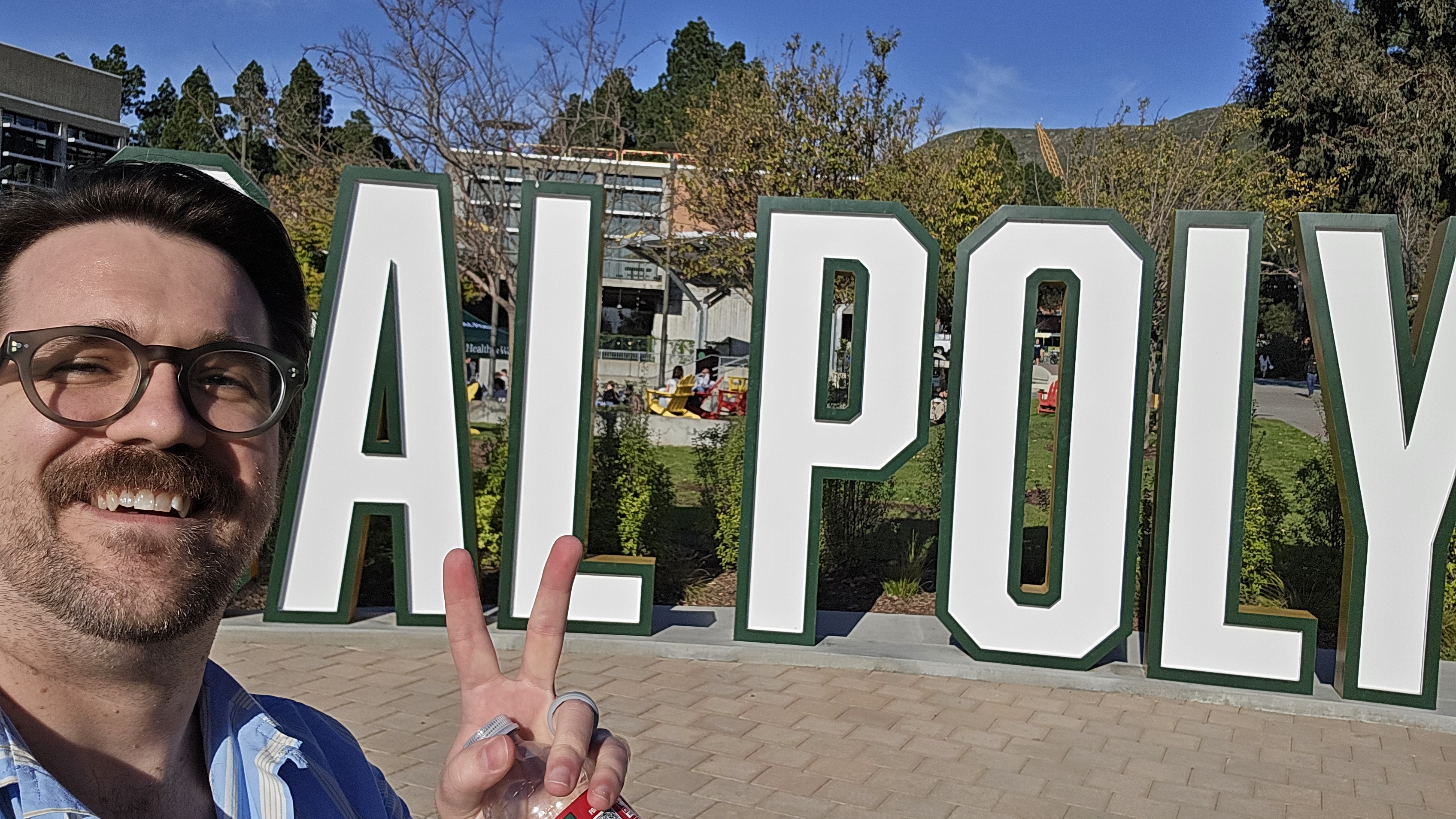
So I want to now officially announce that I’ve accepted a job at Cal Poly (California State University Polytechnic), in San Luis Obispo. It’s a PUI that expects research. It ticks every box I could want. The faculty there have had outstanding research careers, yet the top priority for my tenure evaluation will be on my teaching. People clearly explained that I am evaluated based on having 2 “externally recognized” contributions per year: one might be a peer reviewed paper, another a grant, but I can also get creative (but they let me know the floor!). The master’s students and undergraduates I would be working with are top notch, the pace of life is far more balanced than an R1, and (through my interview process) it was abundantly clear that both my past industry career and my a-typical avenues of impact are highly valued.
That last part sold me on Cal Poly. Stephanie Valencia Valencia, over at UMD told me to “go where you are celebrated” and that “you will know once you’re there if you are or not.” Faculty and the students at Cal Poly saw my industry experience and style of collaboration as a huge benefit to the university. And folks with impressive research agendas spoke very highly of the level of maturity and breadth of impact from my research. It was clear to me that, unlike the R1s I had interviewed at, my past and present styles of work were considered an actual benefit. (Again: I wasn’t created in a test tube and cultivated from adolescence to produce top-cited research papers… I have a broad and varied background. It felt good to be seen for that and valued.)
I am a bit melancholy, to some degree, that I am not a more-typical sort of researcher with a typical profile of research, style of work, set of politics with workers, and arrangement of interests. I would have loved to imagine myself as the hero who slays the dragon at an R1 and gets all the glory. But that isn’t me. I’d be living a dishonest life if I thought that was even what I really wanted, too.
So here’s to a new adventure and embarking on this next arc of my story.
Oh and special thanks to Dominik and Patrick, my advisors. They’ve both been nothing but supportive of me and my goals. I’m thankful for them (and Ken and Jen, both also on my committee) for being so generous with time and advice.